what size gravel to put under reataining wall
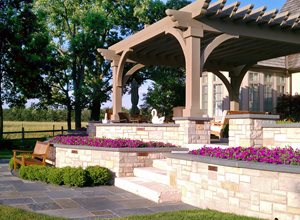
This backyard features a serial of 2-three human foot tall terraced retaining walls that create a unique look and provide usable outdoor space. Romani Landscape Architecture in Glencoe, IL.
A retaining wall is intended to concord back soil when there is a drastic change in elevation. Often retaining walls are used to terrace yards that originally had a steep slope. Additionally, retaining walls can help create usable outdoor infinite every bit well as control erosion, (run across Landscaping a Divide-Level Home.) Low retaining walls are frequently used as planting beds and tin add together involvement to an otherwise flat yard.
If you are considering hiring someone to build a landscape retaining wall on your property yous'll want to have a bones understanding of what goes into proper retaining wall design. This way you'll be sure to get a quality wall that will last for years without problems. An improperly built retaining wall may bulge, crack or lean, creating an cruddy eyesore and a headache for you.
Retaining Wall Installation Tips
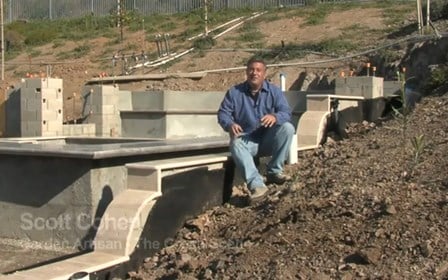
Fourth dimension / 04:42
Meet how retaining walls made of cinderblock topped with travertine can be used to add together structure and beauty to a sloped landscape.
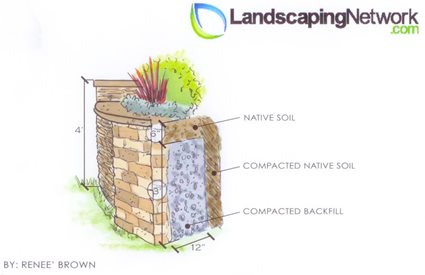
This drawing shows a cantankerous-section of a 4' retaining wall.
-
Base
Beginning, a retaining wall must exist built on a suitable base. Block manufacturers equally well as experienced contractors and engineers stress the importance of starting with a good base. The base of a retaining wall should be prepare below basis level. The taller a wall is, the further beneath ground level it should exist set. Crucial for supporting the rest of the wall, a good base is made of compacted soil and at to the lowest degree a half dozen inch layer of compacted sand and gravel. -
Backfill
2d, a retaining wall must have properly compacted backfill. Backfill refers to the dirt backside the wall. In order to provide proper drainage, at least 12 inches of granular backfill (gravel or a similar amass) should be installed directly backside the wall. Compacted native soil can be used to backfill the rest of the space backside the wall. If y'all intend to do landscaping behind the wall, a six+ inch layer of native soil should also be placed over the gravel fill. -
Drainage
Third, since well-nigh retaining walls are impervious, which means water cannot laissez passer through the wall itself, efficient drainage is crucial. When drainage goes unaddressed hydrostatic pressure will build up behind the wall and cause harm such every bit bulging or corking. There are a number of means to ensure proper drainage of h2o from behind a retaining wall. First, is to brand sure your landscaping contractor backfills at to the lowest degree a pes of infinite behind the wall with gravel. 2d, is having a perforated pipage installed along the within, or backfilled, bottom of the wall. And third, is to inquire if weep holes volition exist needed to permit h2o to drain through the wall. -
Superlative
Fourth, information technology's important to know that the summit of a retaining wall determines the load it can bear and how much extra reinforcement will be necessary. Typically, residential retaining walls are built between 3 and 4 anxiety high. This elevation provides fantabulous forcefulness without requiring anchors, cantilevers or other additional reinforcements. If your property requires a higher wall you have ii options: yous tin have the wall peculiarly designed by an engineer or you can apply a series of 3-iv human foot walls to create a terraced consequence.
Using Waterproof Membranes
Moisture tin can remain behind a retaining wall long later the runoff is gone. It seeps into the masonry traveling straight through. On the dry side it will evaporate leaving backside mineral efflorescence or discoloring mildew. Moisture is the enemy of decorative veneer such as stucco, rock and tile. This is why it'due south essential to utilize a substantial waterproof membrane on the back of every retaining wall just every bit it is applied to the back of basement walls where the same weather occur. In that location are various types of membranes, and your contractor will know the virtually effective one for your local climate and soil type. Any time you put soil behind a wall, be sure to employ membranes to protect the dazzler of its face up.
Retaining Wall Blueprint Ideas:
- Incorporate a fountain or water feature into your retaining wall
- Integrate an outdoor fireplace into your retaining wall design
- Install mural lighting in your retaining wall
- Include built-in bench seating in your retaining wall
- Don't forget steps if you plan to admission the expanse above the wall
- For a finished look, have wall caps installed
floresunearithe55.blogspot.com
Source: https://www.landscapingnetwork.com/walls/retaining.html
0 Response to "what size gravel to put under reataining wall"
Postar um comentário