Project Map Making the Arts Possible El Paso Tx
What began as an arts-driven guerilla marketing campaign for the fictional render of a historic streetcar in the border communities of El Paso, TX and Ciudad Juárez, Mexico, is becoming a reality; a demonstration of the power of art to capture the imagination of a community and assistance them await at old problems in different means and imagine artistic solutions.
The challenge
Dissimilar San Diego, California and Tijuana, Mexico, which are separated past twenty miles, El Paso, TX and Juárez, Mexico sit next to one another, separated simply by the width of the Rio Grande and the invisible international border between the United States and Mexico. Until 1846, El Paso was in fact part of Juárez and Mexico, and the two independent cities today form the world'south largest binational metroplex, with thousands of daily crossings by foot, car, and autobus; billions of dollars of merchandise; and five border crossings connecting the two cities and region. For generations, residents on both sides of the border have crossed ofttimes for work, schoolhouse, recreation, and to visit family unit; more than than lxxx% of El Pasoans place as Latinx.
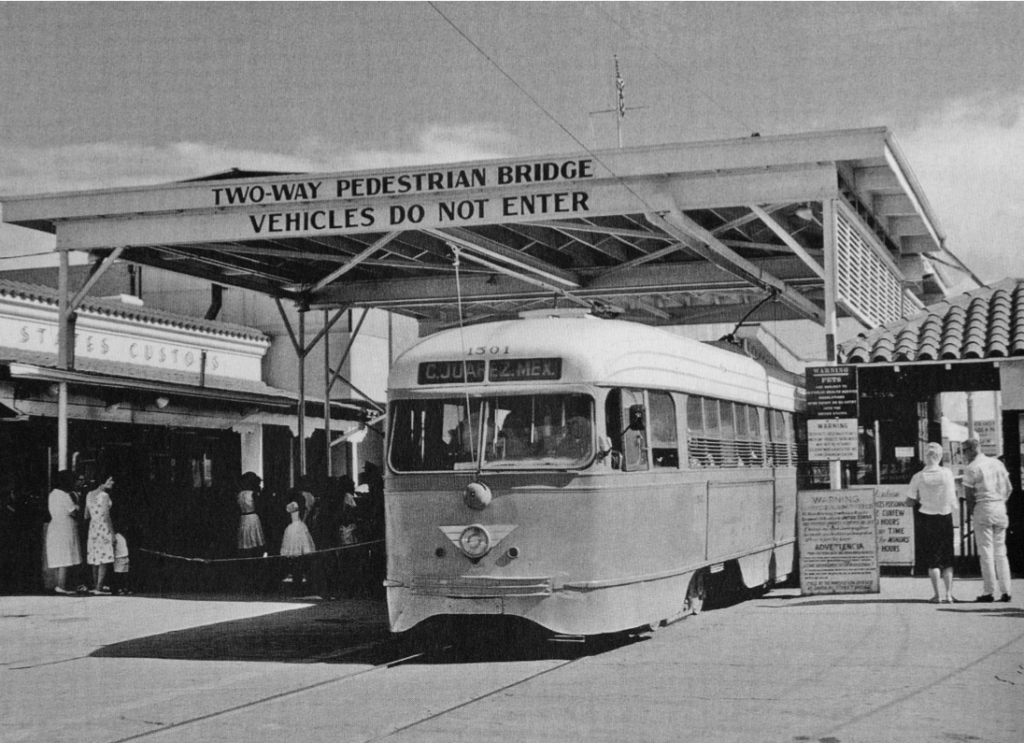
Until 1974, these border crossings were facilitated past an international streetcar system that connected the downtowns of both cities. Every bit in many American cities, the streetcar system ran President'due south Conference Commission (PCC) streetcars, with a sleek Fine art Deco design that was introduced after the Great Depression, to lure new auto owners back onto public transportation. Thank you to the region'southward dry climate, the dormant streetcars take remained in relatively good shape for the past four decades. Now that drug cartel-related violence in Juárez has drastically decreased, interest in exploring improved border crossings has increased.
The projection
The iconic streetcars, stored in the open desert at the border of El Paso, and stories of their transnational by, served as the inspiration for Peter Svarzbein's Masters of Fine Arts thesis projection at New York'due south School for Visual Arts. In 2012 Mr. Svarzbein, a native of El Paso, created the El Paso Transnational Trolley, which could be described as part performance art, part guerrilla marketing, part visual art installation, and part fake advertising entrada.

The project began with a serial of wheatpaste posters advertisement the return of the El Paso-Juárez streetcar, and continued with the deployment of Alex the Trolley Usher, a new mascot and spokesperson for the declared new service. Alex appeared at Comic Cons, public parks, conferences, and other public spaces to promote the return of the streetcar, while additional advertisements appeared across El Paso, sparking curiosity and excitement for the assumed real project.
Eventually, Svarzbein admitted that the project was a graduate thesis masquerading as a streetcar launch, but rather than graduating and moving on, he decided to motion back dwelling to El Paso. When Svarzbein learned that the Metropolis of El Paso planned to sell the historic PCC streetcars, he lobbied the city to abolish the sale, and instead return the streetcars to the streets of El Paso. After gathering thousands of signatures in support of the project and with synergy from the City of El Paso and Texas Department of Transportation (TxDOT) Commissioner, Ted Haughton, the El Paso trolley won a $97 million grant from the TxDOT. Information technology is at present slated to begin service in El Paso in 2018. The 3rd phase of the project will include a connexion to the Medical Center of the Americas, while the second will include the much anticipated transnational connection to Juárez. Not long subsequently this funding was awarded, Svarzbein rode the wave of public support for the fictional projection to win a seat on El Paso's City Council.
The El Paso Transnational Trolley Project'southward website quotes artist Guillermo Goméz-Peña:
An artist thinks differently, imagines a better world, and tries to return information technology in surprising means. And this becomes a way for his/her audiences to feel the possibilities of freedom that they tin't find in reality.
Clearly, Svarzbein credits his creative entrada with helping to get the project off the footing and edifice the community support needed to win funding, claiming that "in that location is a sort of responsibility that artists take to imagine and speak about a future that may non be able to be voiced past a big amount of people in the nowadays. I felt that sort of responsibility. If I couldn't change the contend, at least I could sort of write a love letter to the place that raised me."

The results
On Monday, November 12, 2018, the El Paso Streetcar opened for full service, with 2 interconnected, uptown and downtown loops. The loops connect the University of Texas at El Paso with many other neighborhoods and downtown.
As a city councilman, Svarzbein voted for phase two of the streetcar—which would extend the service to the El Paso Medical Eye of the Americas—and introduced legislation to practise a feasibility study on phase 3, which would restore transnational service to Ciudad Juárez.
In the El Paso region, "we've always viewed the border every bit an opportunity, not equally a threat," according to Svarzbein. A transnational streetcar arrangement would provide greater economical opportunity for the entire region, enhancing relations betwixt the ii sis cities and facilitating the exchange of goods and ideas. To that terminate, as part of the regional 2045 plan—Destino 2045—in that location is an international pedestrian transportation system envisioned within the next x-15 years.
The story of El Paso's streetcar is another example of how transportation professionals are exploring new, creative, and contextually-specific approaches to planning and building transportation projects. They are collaborating with artists and the community in new ways to transform transportation systems into powerful tools to aid people access opportunity, drive economic development, improve health and safety, and build the civic and social capital that binds communities together.

Key Partners: Peter Svarzbein, City of El Paso, Sun Metro
floresunearithe55.blogspot.com
Source: https://www.transportation.art/2021/04/05/el-paso-transnational-trolley-2/
0 Response to "Project Map Making the Arts Possible El Paso Tx"
Postar um comentário